

Technical Co-Founder, Fractional CTO, Dev Agency, or Venture Studio: How to Choose the Right Technology Partner

Project Manager

Building software has never been easier. Building a successful startup has never been harder.
AI can generate prototypes, write code, and accelerate development in ways that were unimaginable a few years ago. Yet investors are becoming more selective, customers expect immediate value, and competition is growing faster than ever. According to TechCrunch’s 2026 VC outlook, investors are increasingly prioritizing startups with clear market demand, sustainable growth, and proven business value over hype-driven concepts. At the same time, Pluralsight’s 2026 Technology Forecast shows organizations shifting their focus from AI experimentation to measurable business outcomes.
This creates a common challenge for business owners and non-technical founders. They understand the problem, the market, and the customer. What they often lack is the technical leadership, product strategy, engineering expertise, and execution framework needed to turn that knowledge into a scalable business. That’s where the confusion begins. Do you need a technical co-founder, a fractional CTO, a software development agency, or a venture studio? Each solves a different problem, carries a different level of risk, and can dramatically impact your startup’s trajectory. Choosing the right technology partner starts with understanding what your business actually needs.
Before Choosing a Technology Partner, Identify the Real Gap
Many founders assume they need a developer, CTO, software development agency, or technical co-founder when what they actually need is clarity. The biggest risk at an early stage is not a lack of engineering talent. It’s solving the wrong problem, building the wrong product, or investing in technology before validating market demand. Before evaluating a technical co-founder, fractional CTO, development agency, or venture studio, founders should identify the specific gap holding the business back.
For some companies, the challenge is product discovery and market validation. Others need technical architecture, AI strategy, UX design, security planning, or MVP development. Some have already built a product but struggle with go-to-market execution, fundraising readiness, technical hiring, or ongoing product iteration. Each of these challenges requires a different type of partner, which is why the right choice depends less on who can build and more on what the business needs to achieve next.
If you know exactly what to build, who will buy it, how the product creates value, and what your roadmap looks like, a software development agency may be enough. But if you’re still validating the opportunity, defining the product strategy, exploring AI integration, preparing for investors, or building the foundation for long-term growth, execution alone won’t solve the problem. The most valuable partner is the one that helps close the gap between where your business is today and where it needs to be tomorrow.
Quick comparison: Technical Co-Founder vs Fractional CTO vs Dev Agency vs Venture Studio

When to Choose a Technical Co-Founder
A technical co-founder is the right choice when technology is central to your business model, competitive advantage, and long-term growth strategy. Unlike a contractor, agency, or fractional executive, a technical co-founder operates as an owner, shares the risk, and is responsible for the product’s technical vision from day one through scale.
Best-Fit Situations
- You’re building a technology-first startup where the product is the business.
- Technology is your primary competitive advantage or intellectual property.
- You need long-term technical leadership, not just product development.
- You’re prepared to share equity and strategic decision-making authority.
- The product requires complex architecture, AI, data, integrations, or scalability planning.
- You need someone to lead technical hiring and build an engineering culture.
- You’re seeking investor confidence through a strong founding team.
- You plan to build and scale the company over the next 5 to 10 years.
When to Choose a Fractional CTO
A fractional CTO is the right choice when your business needs senior technology leadership but does not yet require, or cannot justify, a full-time Chief Technology Officer. They provide strategic guidance, technical oversight, and executive-level decision-making without the long-term cost of a permanent hire.
Best-Fit Situations
- You have a development team but lack technical leadership.
- You’re building an MVP and need architecture decisions made correctly from the start.
- You need to evaluate or manage a software development agency.
- Your startup is preparing for fundraising and investor due diligence.
- You’re scaling a product and need guidance on performance, security, and infrastructure.
- You need help selecting the right technology stack, AI tools, or cloud strategy.
- You’re hiring your first engineering team and need leadership support.
- Your existing product has technical debt, scalability issues, or inconsistent development practices.
- You need a technology roadmap aligned with business goals.
- You want executive-level technology expertise without a full-time CTO salary.
When to Choose a Development Agency
A development agency is the right choice when you have a validated idea, a clear product vision, defined requirements, and need a team to execute design, development, testing, and deployment efficiently.
Best-Fit Situations
- You know exactly what product needs to be built.
- Product-market fit has been validated or customer demand is clear.
- You have documented requirements, user stories, or a roadmap.
- You need an MVP developed quickly and efficiently.
- Your internal team lacks development bandwidth.
- You need specialized skills such as AI, mobile, cloud, DevOps, or UX/UI design.
- You want a predictable project budget and timeline.
- You need to modernize, redesign, or extend an existing application.
- You need a dedicated team without the complexity of hiring in-house talent.
- You have a product owner or business leader who can provide direction and make decisions.
When to Choose a Venture Studio
If you’re looking for more than a development partner and need support across product strategy, technology, validation, fundraising readiness, and growth, a venture studio may be the right fit. It is designed for founders and domain experts who need a team to help turn market insights into a scalable, investor-ready business.
Best-Fit Situations
- You have deep industry expertise and a strong business idea but lack a technical co-founder or product team.
- You need help validating the market opportunity before investing heavily in product development.
- You’re building a startup from scratch and need support across strategy, product, technology, and go-to-market execution.
- You want a partner who can help reduce product, technical, and business risk while accelerating time-to-market.
- You’re looking for a technology partner that can contribute strategic thinking, not just software development.
- You need guidance on product-market fit, fundraising readiness, customer acquisition, and growth strategy.
- You want a long-term venture-building partner that can help take an idea from concept to scale
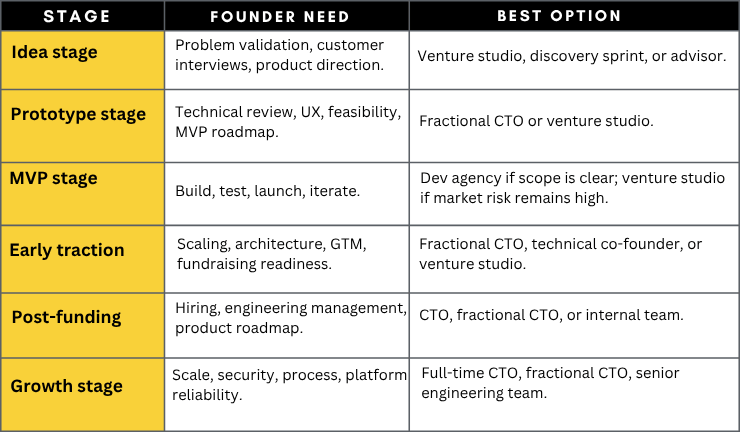

Decision Framework: Which Technology Partner Should You Choose?
1. Choose a Technical Co-Founder When You Need Long-Term Technical Ownership
A technical co-founder is best when technology is central to your business model and competitive advantage. Choose this path if you need someone to own the product vision, architecture, engineering culture, and technical roadmap for years, not just the first build.
2. Choose a Fractional CTO When You Need Senior Technical Leadership
A fractional CTO is the right fit when you need strategic technology guidance but are not ready for a full-time CTO. This works well if you already have developers, vendors, or an agency and need someone to guide architecture, technical decisions, security, scalability, and engineering execution.
3. Choose a Development Agency When You Need Reliable Execution
A development agency is best when your product scope is clear, the business requirements are defined, and you need a team to design, build, test, and launch efficiently. This model works well when you know what needs to be built and need speed, capacity, and specialized technical skills.
4. Choose a Venture Studio When You Need End-to-End Venture Building
A venture studio is the right choice when you need more than software development. It helps with market validation, product strategy, MVP development, technology execution, go-to-market planning, fundraising readiness, and long-term growth.
5. Choose Based on Your Biggest Risk
If your biggest risk is technical leadership, consider a fractional CTO. If your biggest risk is execution, choose a development agency. If your biggest risk is turning an idea into a validated, scalable, fundable business, a venture studio may be the strongest fit.
6. Choose Based on Your Stage, Not Just Your Budget
Early-stage founders often need clarity, validation, and product strategy before development. Growth-stage companies may need technical leadership or execution capacity. The right model depends on where the business is today, what must be proven next, and what kind of partner can reduce risk fastest.
How ISHIR Helps Founders Build, Scale, and Fund Technology Products
Every startup journey is different, which is why there is no one-size-fits-all technology partner. At ISHIR, we help founders, business owners, and startup teams choose the model that aligns with their stage, goals, and biggest business challenges. Whether you need strategic technology leadership, product development expertise, a technical co-founder alternative, or end-to-end venture-building support, our team can help bridge the gap between an idea and a scalable business.
If you already have a product vision and need execution, ISHIR’s software development teams can design, build, modernize, and scale digital products with expertise across AI, SaaS, cloud, web, mobile, and enterprise platforms. If you’re looking for senior technology leadership without the cost of a full-time executive, our Fractional CTO services provide guidance on architecture, product roadmaps, engineering strategy, technical hiring, security, scalability, and investor readiness.
For founders who have deep industry knowledge but lack a technical co-founder or venture-building team, Texas Venture Studio by ISHIR offers a more comprehensive approach. We work alongside founders to validate opportunities, define product strategy, build MVPs, accelerate product-market fit, develop go-to-market plans, and prepare ventures for growth and funding. Acting as a technology co-founder and venture-building partner, we help transform market insights and business expertise into scalable, investor-ready products while reducing product, technical, and execution risk along the way.
Have an idea but no technical co-founder?
Texas Venture Studio by ISHIR helps founders validate, design, build, and launch AI-native products with a co-building model.
FAQs
Q. Do I Need a Technical Co-Founder to Build a Startup?
Not necessarily. A technical co-founder is valuable when technology is core to the company’s long-term competitive advantage and requires continuous innovation. However, many successful founders start with a fractional CTO, software development agency, or venture studio to validate their idea and build an MVP before bringing on a technical co-founder.
The right choice depends on your business stage, budget, technical complexity, and growth goals. If you’re still validating the problem or testing market demand, you may not need a full-time technical co-founder immediately. What matters most is having access to the right technical expertise at the right time.
Q. What’s the Difference Between a Venture Studio and a Software Development Agency?
A software development agency primarily focuses on execution. They design, build, test, and deploy software based on defined requirements. A venture studio takes a broader approach by helping founders validate ideas, shape product strategy, build MVPs, achieve product-market fit, develop go-to-market plans, and prepare for growth.
If you already know exactly what to build, a development agency may be enough. If you’re still defining the opportunity, validating demand, or building a startup from the ground up, a venture studio can provide additional strategic and operational support beyond development.
Q. When Should a Startup Hire a Fractional CTO Instead of a Full-Time CTO?
A fractional CTO is often the best choice when a startup needs senior technical leadership but cannot justify the cost of a full-time executive. They provide guidance on technology strategy, architecture, engineering processes, vendor management, security, scalability, and technical hiring.
Many startups use a fractional CTO during the MVP, seed, and early growth stages. Once the company reaches significant scale, manages larger engineering teams, or requires daily executive involvement, transitioning to a full-time CTO may become the better option.
Q. How Do I Build an MVP Without a Technical Co-Founder?
There are several ways to build an MVP without a technical co-founder. Founders often work with a software development agency, hire a fractional CTO to oversee development, use low-code tools for early validation, or partner with a venture studio that provides product, engineering, and strategic support.
The most important step is validating the problem before investing heavily in development. A successful MVP should prove customer demand, test assumptions, and generate actionable feedback rather than attempt to launch a fully featured product.
Q. What Is the Best Technology Partner for a Non-Technical Founder?
The best technology partner depends on the founder’s goals and stage of growth. A technical co-founder is ideal for long-term technical ownership. A fractional CTO is suitable for strategic guidance. A development agency works well when requirements are clear and execution is the primary need. A venture studio can be valuable when founders need support across validation, product strategy, technology, go-to-market planning, and growth.
Before choosing a partner, founders should identify their biggest challenge. In many cases, the problem is not development capacity but uncertainty around product-market fit, customer demand, or business strategy.
Q. How Much Does It Cost to Build a Startup MVP in 2026?
The cost of building an MVP varies significantly based on product complexity, industry requirements, AI capabilities, integrations, security needs, and development approach. A simple MVP may require a relatively modest investment, while AI-driven SaaS platforms or enterprise-grade products often require substantially more.
Instead of focusing solely on development costs, founders should focus on the cost of learning. The goal of an MVP is to validate assumptions and reduce business risk before making larger investments in product development and growth.
Q. Is a Venture Studio Worth It for Early-Stage Startups?
A venture studio can be valuable for founders who have strong domain expertise but lack product, technology, operational, or startup-building experience. Venture studios often help reduce risk by providing structured support across validation, product development, market testing, growth planning, and fundraising readiness.
The key is finding a venture studio with clear alignment, transparent expectations, and a proven process. Founders should evaluate how the studio contributes beyond software development and whether its involvement helps accelerate business outcomes.
Q. How Do Investors Evaluate Startups Without a Technical Founder?
Investors typically evaluate more than just the founding team’s technical background. They look for evidence of customer demand, market opportunity, execution capability, product traction, revenue potential, and the startup’s ability to solve a meaningful problem.
For non-technical founders, having strong technical leadership through a co-founder, fractional CTO, venture studio, or experienced product team can increase credibility. Investors want confidence that the company can execute effectively, scale responsibly, and deliver on its vision.
About ISHIR:
ISHIR is a Dallas Fort Worth, Texas based AI-Native System Integrator and Digital Product Innovation Studio. ISHIR serves ambitious businesses across Texas through regional teams in Austin, Houston, and San Antonio, along with presence in Singapore and UAE (Abu Dhabi, Dubai) supported by an offshore delivery center in New Delhi and Noida, India, along with Global Capability Centers (GCC) across Asia including India (New Delhi, NOIDA), Nepal, Pakistan, Philippines, Sri Lanka, Vietnam, and UAE, Eastern Europe including Estonia, Kosovo, Latvia, Lithuania, Montenegro, Romania, and Ukraine, and LATAM including Argentina, Brazil, Chile, Colombia, Costa Rica, Mexico, and Peru.
ISHIR also recently launched Texas Venture Studio that embeds execution expertise and product leadership to help founders navigate early-stage challenges and build solutions that resonate with customers.
Get Started
Fill out the form below and we'll get back to you shortly.