

Why Your Website May Become Irrelevant in an AI Agent Economy

Manager, AI

The next customer who buys from your business may never visit your website.
No homepage.
No product demo.
No “Contact Sales” form.
No procurement calls.
No negotiation meetings.
Instead, their AI agent will interact directly with your AI systems.
It will:
- Evaluate your offerings
- Compare competitors instantly
- Analyze pricing models
- Verify compliance
- Negotiate discounts
- Assess operational risk
- Finalize recommendations
All before a human even enters the conversation. That shift changes far more than customer experience.
It changes how businesses are discovered. How trust is established. How pricing works. How procurement decisions happen. How digital infrastructure is designed.
And most enterprises are nowhere near ready for it.
Right now, many organizations still think AI transformation means:
- Deploying chatbots
- Adding copilots
- Automating support workflows
But the real disruption is operational.
We are entering an AI agent economy where autonomous systems will increasingly make decisions, negotiate transactions, and execute workflows on behalf of both customers and enterprises. In that environment, traditional websites become less important.
Because AI agents do not browse websites the way humans do.
They consume:
- Structured data
- APIs
- Machine-readable trust signals
- Real-time pricing
- Operational intelligence
If your business still relies on static websites, hidden pricing, manual procurement, and disconnected systems, you are optimizing for a buying process that is rapidly disappearing. And when AI agents begin negotiating pricing autonomously, enterprises that fail to redesign their operational architecture will face a serious competitive disadvantage.
The companies that win in the next decade will not simply “use AI.” They will build AI-native businesses designed for AI-to-AI interaction from the ground up.
Why Traditional Websites May Become Less Relevant
For the last two decades, enterprise websites have been designed around human behavior. Buyers visit websites to explore products, compare features, read reviews, download brochures, request demos, and contact sales teams. Every page, CTA, navigation menu, and pricing section is built to guide human decision-making through a visual and interactive experience. Businesses compete on design, content, SEO rankings, and conversion funnels because humans are the primary users consuming that information.
That model is now starting to change. In an AI agent economy, autonomous AI systems will increasingly interact directly with enterprise systems instead of browsing websites like humans. AI agents will consume structured product data, APIs, pricing logic, compliance documentation, operational metrics, and trust signals in machine-readable formats to make decisions faster and more accurately. Instead of navigating landing pages or filling out forms, AI agents will evaluate vendors, compare pricing, verify compliance, negotiate contracts, and initiate procurement workflows automatically, often before a human even becomes involved. This shifts digital commerce away from interface-first experiences toward infrastructure-first ecosystems where machine accessibility becomes more important than visual presentation.
AI-Agent-Ready Website Checklist
- Is your product and service data machine-readable?
- Can AI agents access your systems through APIs?
- Is your pricing transparent and dynamically accessible?
- Can AI systems verify your compliance and security standards instantly?
- Are your SLAs, uptime, and operational metrics machine-consumable?
- Can AI agents evaluate your offerings without human assistance?
- Is your procurement workflow automation-ready?
- Do your systems support real-time AI-driven decision-making?
- Have you implemented AI governance and permission controls?
- Can your infrastructure support autonomous AI-to-AI transactions?
The Operational Infrastructure Enterprises Actually Need
Structured Data Architecture
AI agents cannot interpret fragmented, inconsistent, or unstructured business data efficiently. Enterprises need standardized, machine-readable data across products, pricing, compliance, operations, and services to enable accurate AI-driven evaluation and decision-making.
Real-Time Decision Systems
Static workflows and delayed approvals cannot support autonomous AI operations. Businesses need infrastructure capable of processing live data, triggering instant decisions, and adapting dynamically based on changing operational conditions.
Dynamic Pricing Infrastructure
Fixed pricing models will struggle in environments where AI agents continuously compare vendors and negotiate terms automatically. Enterprises need flexible pricing systems that support dynamic negotiation, usage-based pricing, and real-time pricing adjustments.
AI Governance and Permission Controls
As AI agents gain decision-making authority, enterprises need clear governance frameworks defining what AI systems can access, approve, negotiate, or escalate. Without controlled permissions, autonomous operations create significant operational and compliance risks.
AI-Native Workflow Design
Most enterprise workflows were designed for human interaction and manual coordination. AI-native workflows must support autonomous execution, cross-system communication, continuous optimization, and machine-driven operational efficiency.
5 Capabilities Enterprises Need Before AI-to-AI Commerce Becomes Mainstream
- Structured Data Architecture
AI agents rely on machine-readable data to evaluate products, services, pricing, and operational capabilities. Enterprises with fragmented or unstructured data will struggle to participate effectively in AI-driven commerce. - API-First Infrastructure
AI agents need direct system access to exchange information, validate decisions, and execute workflows in real time. Businesses built around manual processes and interface-only systems will face major operational limitations. - Real-Time Decision Systems
Autonomous AI interactions require instant processing of pricing, inventory, approvals, compliance, and operational conditions. Static workflows and delayed decision-making cannot support AI-speed transactions. - AI Governance and Permission Controls
Enterprises must define what AI agents can access, negotiate, approve, or escalate. Without governance frameworks, autonomous systems introduce security, compliance, and operational risks. - Dynamic Pricing and Procurement Infrastructure
AI agents will continuously compare vendors, benchmark pricing, and negotiate contracts automatically. Businesses need flexible pricing systems and AI-ready procurement workflows to remain competitive in real-time negotiations.
Why Most AI Strategies Are Already Outdated
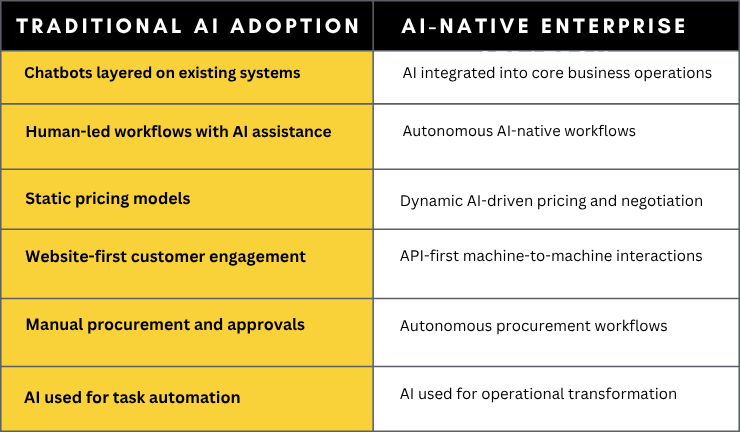

Enterprise Action Plan for the AI Agent Economy
Audit Your Digital Infrastructure
Start by evaluating whether your systems are designed for human interaction or AI interaction.
Most enterprise environments still depend on:
- Manual workflows
- Disconnected systems
- Static data
- Interface-heavy processes
AI agents cannot operate efficiently in that environment.
Reevaluate Your Pricing Strategy
Static pricing models are not built for autonomous negotiation environments.
AI agents will:
- benchmark competitors instantly
- compare pricing dynamically
- negotiate based on performance and value
- optimize procurement continuously
Enterprises need pricing infrastructure that supports flexibility, transparency, and real-time adaptability.
Build AI Governance Frameworks
As AI agents gain operational authority, governance becomes critical.
Define:
- What AI agents can approve
- What requires human escalation
- Access permissions
- Compliance boundaries
- Audit and accountability processes
Without governance, autonomous systems create operational and regulatory risk.
Redesign Workflows for AI-Native Operations
Most workflows today are designed around human bottlenecks:
- Approvals
- Handoffs
- Emails
- Meetings
- Manual coordination
AI-native workflows should support:
- Autonomous execution
- Real-time decisions
- Continuous optimization
- Cross-system intelligence
This requires operational redesign, not just automation.
Prepare for AI-to-AI Trust Models
Trust in AI-driven commerce will become data-driven, not marketing-driven.
AI agents will increasingly evaluate:
- Uptime history
- SLA performance
- Compliance records
- Security certifications
- Operational reliability
Enterprises need infrastructure that exposes verifiable trust signals in machine-accessible formats.
How ISHIR Helps Enterprises Build AI-Native Operations
The shift toward AI-to-AI commerce requires more than deploying chatbots or adding automation layers. Enterprises need AI-native operational infrastructure capable of supporting autonomous decision-making, intelligent workflows, dynamic pricing interactions, and machine-to-machine communication at scale. That requires the right architecture, governance models, data infrastructure, and AI strategy from the ground up.
ISHIR helps enterprises build future-ready AI ecosystems through advanced AI agent development services and enterprise AI solutions tailored to real operational challenges. From autonomous AI agents and AI-powered workflow automation to AI-native platforms and real-time decision systems, ISHIR enables organizations to move beyond experimental AI adoption and build scalable operational intelligence that delivers measurable business impact.
Whether enterprises are preparing for AI-driven procurement, autonomous customer engagement, dynamic pricing systems, or AI-native workflow transformation, ISHIR helps design and implement the infrastructure required for the next generation of digital commerce. Our expertise spans AI agent development, enterprise AI integration, intelligent automation, governance frameworks, API-first architectures, and AI operational modernization to help businesses stay competitive in an increasingly autonomous economy.
Is Your Enterprise Ready for AI-to-AI Commerce and Autonomous Pricing Negotiations?
ISHIR helps enterprises build AI-native operational infrastructure with advanced AI agent development services and enterprise AI solutions designed for the next generation of autonomous business interactions.
Frequently Asked Questions
Q. What is the AI agent economy?
The AI agent economy refers to a business environment where autonomous AI systems interact, evaluate, negotiate, and transact on behalf of customers and enterprises. Instead of humans manually comparing vendors or negotiating contracts, AI agents will increasingly make operational decisions in real time. This changes how businesses approach commerce, procurement, pricing, and customer engagement.
Q. Will AI agents replace traditional websites?
Websites will not disappear completely, but their role will change significantly. AI agents do not browse websites like humans. They rely on structured data, APIs, pricing logic, compliance information, and operational trust signals to make decisions. Enterprises that only optimize for human browsing may struggle to remain visible in AI-driven commerce environments.
Q. How will AI agents negotiate pricing?
AI agents can analyze market benchmarks, compare vendors instantly, evaluate contract terms, and negotiate pricing dynamically based on predefined business goals. This creates faster and more data-driven procurement processes. Enterprises using static pricing models may face increasing pressure in environments where AI systems continuously optimize purchasing decisions.
Q. Why are most enterprise AI strategies already outdated?
Many organizations still treat AI as a productivity or chatbot tool layered onto existing workflows. The real shift is operational. AI-native enterprises are redesigning workflows, pricing systems, procurement models, and decision infrastructure to support autonomous AI interactions. Businesses focused only on automation may fall behind competitors building AI-native operational ecosystems.
Q. What infrastructure do enterprises need for AI-to-AI commerce?
Enterprises need structured data architecture, API-first systems, real-time decision infrastructure, AI governance frameworks, dynamic pricing capabilities, and machine-readable compliance systems. These capabilities allow AI agents to evaluate, trust, and transact with enterprise systems efficiently without relying on manual human intervention.
Q. Why is structured data important in an AI agent economy?
AI agents depend on machine-readable data to interpret products, pricing, operational capabilities, and compliance information accurately. Unstructured or disconnected data makes it difficult for AI systems to evaluate a business effectively. Structured data becomes essential for discoverability, trust, and participation in AI-driven commerce ecosystems.
Q. How can enterprises prepare for autonomous AI procurement?
Organizations should begin by modernizing procurement workflows, exposing operational systems through APIs, standardizing pricing structures, and implementing AI governance controls. Enterprises also need infrastructure capable of supporting real-time negotiations, automated approvals, and machine-driven vendor evaluation processes.
Q. What role does AI governance play in autonomous operations?
As AI agents gain authority to make operational decisions, governance becomes critical. Enterprises need clear controls around permissions, approvals, escalation rules, compliance boundaries, and accountability. Without governance frameworks, autonomous AI systems can introduce security, regulatory, and operational risks at scale.
About ISHIR:
ISHIR is a Dallas Fort Worth, Texas based AI-Native System Integrator and Digital Product Innovation Studio. ISHIR serves ambitious businesses across Texas through regional teams in Austin, Houston, and San Antonio, along with presence in Singapore and UAE (Abu Dhabi, Dubai) supported by an offshore delivery center in New Delhi and Noida, India, along with Global Capability Centers (GCC) across Asia including India (New Delhi, NOIDA), Nepal, Pakistan, Philippines, Sri Lanka, Vietnam, and UAE, Eastern Europe including Estonia, Kosovo, Latvia, Lithuania, Montenegro, Romania, and Ukraine, and LATAM including Argentina, Brazil, Chile, Colombia, Costa Rica, Mexico, and Peru.
ISHIR also recently launched Texas Venture Studio that embeds execution expertise and product leadership to help founders navigate early-stage challenges and build solutions that resonate with customers.
Get Started
Fill out the form below and we'll get back to you shortly.